
CodeQR is a QR code and short-link platform that offers the same dynamic QR codes and scan analytics as Flowcode at roughly one-third the price — its Business plan runs $69 against Flowcode's Growth plan at $250, with no required sales call.[^1][^4] The honest trade-off: Flowcode's premium design templates are more polished out of the box.
Why people look for a flowcode alternative
Most people searching for a flowcode alternative are reacting to price. Flowcode's free plan stops at 2 Flowcodes and 500 scans, and its higher self-serve and enterprise tiers climb quickly — the Growth plan is $250.[^1] If you generate more than a handful of dynamic codes, the per-code cost is the trigger, not the feature set. Design polish rarely justifies the gap for high-volume users.
What Flowcode does well
Flowcode has real strengths, and if these match what you need, it may be the better fit.
- Premium design templates. Flowcode's branded QR templates are polished and reduce the design work needed to ship a good-looking code.
- US enterprise sales motion. Flowcode runs a structured enterprise sales process, which suits larger buyers who want guided onboarding and procurement support.
- Established free entry point. Flowcode's free plan lets you test 2 Flowcodes with analytics up to 500 scans before paying anything.[^1]
Where Flowcode is the right call
If your team needs hands-on enterprise onboarding with a dedicated account contact and procurement paperwork, Flowcode's US sales motion is more mature here, and choosing Flowcode is the reasonable call. The same is true if design is the priority: a marketing team that wants pixel-tuned branded templates with minimal in-house design effort will get there faster with Flowcode's template library. Pay for the polish if the polish is the point.
Feature comparison
Every number below is cited. "Varies by plan" means the exact figure depends on the tier you pick.
| Criteria | Flowcode | CodeQR |
|---|---|---|
| Entry paid price | Pro Plus $25/mo billed annually[^1] | Business $69/mo[^4] |
| Comparable growth tier | Growth $250[^1] | Business $69[^4] |
| Free-tier limit | 2 Flowcodes, 500 scans[^1] | Varies by plan |
| Dynamic QR codes | Yes | Yes |
| Scan analytics | Yes | Yes |
| Required sales call | At higher tiers | None[^4] |
| Design templates | Premium library | Standard |
Where CodeQR is the right call
CodeQR wins on cost efficiency for teams that generate a lot of codes. Each bullet below ties to a feature in production today.
- Roughly one-third the price at comparable tiers. CodeQR Business is $69 against Flowcode Growth at $250.[^1][^4] You get dynamic QR codes and scan analytics without the higher line item.
- 20–30x more QR codes per dollar. At the Business tier's price, the number of codes you can run per dollar is materially higher than Flowcode Growth,[^1][^4] which matters once you scale past a handful of campaigns.
- No required sales call. You can reach CodeQR's paid tiers self-serve,[^4] set up a code in the QR code generator, and start tracking without booking a demo.
More than 100 million U.S. smartphone users scanned a QR code in 2025, up from 89.5 million in 2022,[^2] so the volume you plan for is likely to grow — and cost per code compounds at that scale.
A price comparison in practice
Consider a marketing manager at a 30-person company running 5 campaigns a month, each with its own dynamic QR code plus a few print variants — roughly 15–20 codes live at once, well past Flowcode's free 2-code cap.[^1]
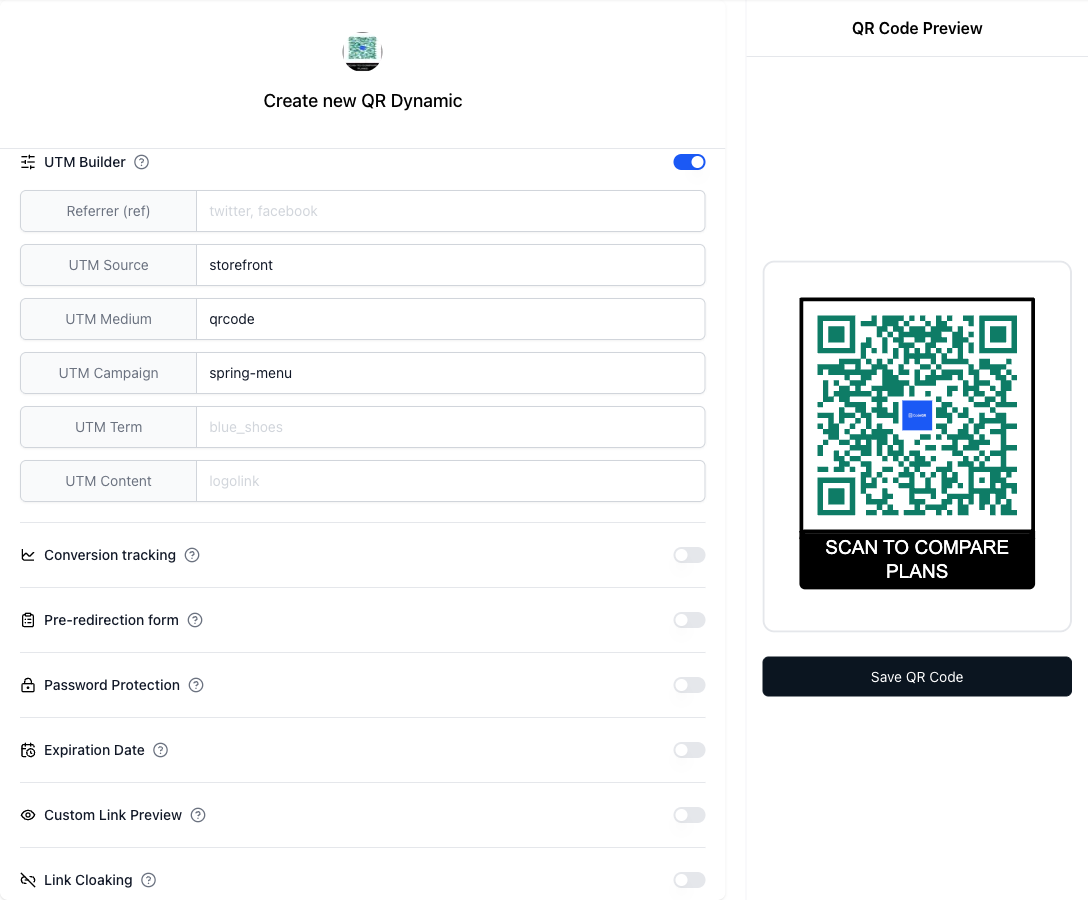
On Flowcode, that manager lands on the Growth plan at $250 to cover the code volume and analytics.[^1] On CodeQR, the same workload fits the Business plan at $69.[^4] The manager gives up Flowcode's premium template library and does slightly more design work per code. In exchange, they keep about $181 a month and can wire campaigns through the UTM builder and add wallet passes for events. For a team measuring cost per campaign, the trade favors CodeQR.
That matters more as 2D barcodes go mainstream: GS1's Sunrise 2027 initiative aims for retailers worldwide to accept QR codes at checkout by the end of 2027, and 79% of consumers said they are more likely to buy products with a scannable QR code that gives extra information.[^3]
How to switch
If CodeQR fits, moving over is short.
- Export your existing code list and scan history from Flowcode so you have a record before you cancel.
- Recreate your active dynamic codes in the CodeQR generator and point them at the same destination URLs.
- Confirm pricing on the pricing page and pick the tier that matches your code volume.
- Update printed or embedded codes only if they were static; dynamic codes keep working when you change the destination.
[^1]: Flowcode pricing — free plan capped at 2 Flowcodes and analytics up to 500 scans; Pro Plus $25/mo billed annually; Growth $250. Flowcode, https://www.flowcode.com/pricing (verified 2026-05-04). [^2]: More than 100 million U.S. smartphone users scanned a QR code in 2025, up from 89.5 million in 2022. Statista, https://www.statista.com/statistics/1337584/number-of-smartphone-qr-code-scanners-usa/. [^3]: GS1's Sunrise 2027 initiative aims for retailers worldwide to accept 2D barcodes such as QR codes at checkout by the end of 2027; a 2025 GS1 US survey found 79% of consumers are more likely to purchase products with a scannable QR code that provides additional product information. GS1 US, https://www.gs1us.org/industries-and-insights/by-topic/sunrise-2027. [^4]: CodeQR pricing — Business plan $69/mo, no required sales call. CodeQR, https://codeqr.io/pricing (verified 2026-07-11).
References
- [1]Flowcode Pricing— Flowcode · 2026-05-04
- [2]Flowcode Features— Flowcode · 2026-05-04
- [3]CodeQR Pricing— CodeQR · 2026-07-11